Cookies are essential for the smooth and secure operation of our website. They help us to monitor performance and provide you with an optimized, personalized user experience.
The cookie settings can be adjusted at any time in the footer of the page.
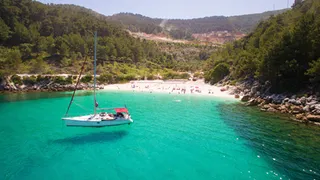
Greece is a dream destination for campers! But since 2025, new rules apply for motorhomes. Here is your ultimate guide covering route options, costs, overnight regulations, and top campsites right by the sea.
Greece is a breathtaking travel destination and regularly comes up in conversations with experienced camping enthusiasts as a top recommendation.
There are many reasons for this: The warm climate makes Greece an extremely flexible, year-round destination for campervan and RV vacations. Prices are often affordable, Greek cuisine is delicious, and the natural beauty seems endless. The many mountains are ideal for hiking, there are bays filled with crystal-clear water, and countless campgrounds right on the beach.
This article provides both practical tips on getting there, rules, and planning, as well as inspiring travel recommendations for regions, campgrounds, and activities. This will make your campervan vacation in Greece absolutely perfect!
Traveling to Greece by Camper: Ferry Route vs. Overland Route
One thing is certain: The trip to Greece is a long one. But we promise you: The journey is definitely worth it. There are several possible routes to choose from, which vary in travel time and cost.
The most common route leads first to Italy. From cities like Ancona, Bari, Brindisi, Ravenna, Trieste, or Venice, there’s a ferry to Patras or Igoumenitsa. This sea route significantly shortens the driving time, but it adds ferry costs that you can save by taking the overland route.
The overland route follows the Balkan Route through Austria, Slovenia, Croatia, Serbia, and North Macedonia. For this trip, you should plan to drive a maximum of 500 to 700 km per day. This is primarily due to the speed limits in the countries you’ll be passing through. So plan for 2 to 3 overnight stays and enjoy the drive through the picturesque countryside.
Tolls, Vignettes, and Documents Required for Entry into Greece
A vignette is not required in Greece itself. It’s best to pay the toll in cash or by card directly at the toll booths on the highways.
Important note regarding your trip: For the routes through Austria and Slovenia, you must obtain a vignette in advance.
Since Greece is part of the EU, your ID card, driver’s license, and the camper’s vehicle registration are all you need to enter the country. Children also need their own identification document. A passport or international driver’s license is not required for EU citizens.
A quick tip for the trip: If you cross the border early in the morning or at night, you’ll avoid long and unnecessary wait times at the checkpoints.
Traffic Rules and Speed Limits When Camping in Greece
Traffic rules in Greece are mostly identical to German regulations. However, you should definitely pay attention to a few important exceptions and road signs along the way.
Keep an eye out for colored parking lines on the curb as well as special no-parking signs along the streets:
Yellow marking: Absolute no-parking zone.
Blue marking: Paid parking lot.
White marking: Free parking allowed.
One vertical line on the no-parking sign (I): No parking in odd months (January, March, May, July, September, November).
Two vertical lines on the no-parking sign (II): No parking in even months (February, April, June, August, October, December).
Attention: In Greece, the statutory right-of-way-to-the-right rule applies unless signs regulate otherwise. This means: Traffic entering the roundabout has the right-of-way!
Speed Limits by Vehicle Type and Weight
In Greece, speed limits depend heavily on your vehicle's gross vehicle weight rating:
Inner city
Out of town
Motorways
Highways
Campervans & motorhomes (up to 3.5t)
50 km/h
90 km/h
110 km/h
up to 130 km/h
Heavy motorhomes (over 3.5t)
40 km/h
80 km/h
80 km/h
80 - 90 km/h
Vehicle combinations (car + caravan)
50 km/h
80 km/h
80 km/h
80 - 90 km/h
Accommodations and Costs: How Much Does Camping Cost in Greece?
One of the many advantages of camping in Greece is the relatively reasonable prices. Compared to other European countries, Greece remains one of the destinations where you can easily enjoy an affordable camping experience.
Food costs at supermarkets and local taverns are noticeably lower than in Germany. It’s best to take advantage of the local weekly markets (Laiki Agora). The fruits and vegetables there are the freshest, and you’ll be directly supporting the local economy.
How affordable a campsite is depends heavily on the season and your personal preferences:
Free campsites: Officially, these are scarce, and due to the ban on wild camping, they should be approached with caution.
Basic campsites / camper stops (with water and waste disposal): Usually cost between 15 and 22 euros per night.
Well-equipped campgrounds (2 people + camper): Cost on average between 22 and 35 euros during the off-season and 35 to 55 euros during the peak season (July/August) right on the beach.
Finding and booking campsites in Greece
If you’re spontaneous, you can just go with the flow and follow the signs on the major roads. Parking spots and campgrounds are often well-signposted in Greece. However, this way you run the risk of searching for a long time or ending up at places that are fully booked.
Once you’ve decided on a region, we recommend making a reservation—especially during the summer months. Whether you can book by phone or online often depends on the location, but the earlier you book, the better your parking spot will be.
Legal Regulations and Fines: Parking vs. Wild Camping in Greece
There’s typically some confusion in Greece when it comes to legally parking and wild camping. The most important thing to understand is the difference between permitted parking and prohibited camping: Under Greek law, RVs and campervans are initially treated like regular vehicles.
You’re generally allowed to park your vehicle in designated public parking areas and spend the night inside, as long as it’s clearly just parking and no camping activity is visible from the outside.
As soon as you set up outside, things get tricky: chairs, tables, grills, clotheslines, extended awnings, or other camping equipment are not permitted in public spaces. In that case, your stay is legally considered illegal wild camping. Wild camping is prohibited in all public spaces—authorities enforce this particularly strictly on beaches, in forests, nature reserves, and near archaeological sites (regulated, among other things, by Tourism Law 5170/2025).
The penalties for violations are severe and are consistently enforced by the police and the coast guard.
Temperature and Climate: The Best Time to Visit Greece
When is the best time to go camping in Greece? The short answer: Spring and early fall offer the perfect conditions!
Midsummer (July & August): For true heat lovers
During the summer months of July and August, temperatures on the mainland and the islands regularly climb well above 35 °C, and during heat waves can even exceed 40 °C. This can make spending the night in a campervan without a stationary air conditioner quite stifling. In addition, there is a high risk of wildfires during this time, which is why some access roads to nature areas are temporarily closed.
If you’re traveling during this time, be sure to pack items that provide shade, always carry plenty of drinking water, and consistently schedule activities for the cooler morning or late evening hours. Water temperatures in the summer range from a delightful 25 °C to 27 °C.
Spring & Fall (May/June & September/October): The Golden Camping Season
Among experienced campers, late spring and early fall are considered the absolute best times to visit Greece:
May & June: Nature is in bloom, daytime temperatures range from a pleasant 22 °C to 28 °C, and the campgrounds are still wonderfully relaxed.
September & October: The Mediterranean is still wonderfully warm from the summer (approx. 23 °C to 25 °C), the oppressive summer heat gives way to mild temperatures of 24 °C to 28 °C, and the hustle and bustle of the peak season has subsided significantly.
The Most Beautiful Places to Camp in Greece Right on the Beach: Destinations
Greece is wonderful. Almost everywhere you go, you can find beautiful scenery, soak up the sun, and breathe in the sea air. Still, there are a few true classics that you shouldn’t miss if you have a little time on your trip. These include the world-famous monasteries of Meteora, the capital city of Athens with the Acropolis, and the islands.
Your road trip starts here!
Whether it’s a weekend trip in a campervan or a big journey in a motorhome – with us, your adventure starts exactly the way you want it.
Find your camper & hit the road 🚐
Camping on Lefkada
Every camper's hidden gem
Lefkada, also known as “Lefkas,” is an island in western Greece and a true dream destination for camping enthusiasts. The main reason for this is the lack of mass tourism. The island is characterized by its traditional charm, white beaches, and a steeply sloping west coast with crystal-clear waters.
Best of all: The island can be reached from the mainland via a toll-free bridge! This makes traveling there by RV extremely easy, since you don’t have to book a ferry.
The Top Campgrounds on Lefkada
Camping Vassiliki Beach: This campground is very large and well-maintained. All campsites are shaded, and the restroom facilities are more than adequate—there is no direct access to the sea from this campground—but the picturesque fishing village of Vassiliki is definitely worth a visit, as it combines many of the things people love about camping in Greece: fresh fish at a fish tavern and sleepy cobblestone alleys
Beach Camping Santa Maura: Located in Desimi Bay in the southeastern part of the island, this campground is set on spacious, shaded terraces and offers the potential for a wonderful stay.
Camping on Thasos
The green island paradise in the northeast
Thasos is located in northeastern Greece and is also known as “The Green Island” because of its dense pine forests and olive groves. The island is ideal for anyone looking for clean water, hiking trails, and traditional mountain villages.
Summer here lasts well into October. Thanks to the Meltémi, the refreshing summer north wind, temperatures remain pleasantly bearable even on hot days at the beach.
Special tip for foodies: Be sure to try Thasos’s famous black Throuba olives and the regional pine honey while you’re there!
The Top Campgrounds on Thasos
The coast is lined with great campgrounds!
The Dedalos Campground is located in the northeast of the island and offers a peaceful, quintessentially Greek camping idyll
The campground at Pefkari Beach is further south and also right by the sea. Camping under olive and pine trees, it doesn’t get any more Greek than this.
Camping on Crete
1.000 km of breathtaking coastline
Crete is the largest of the Greek islands and is located in the very south of the country. Many call it the “Pearl of the Mediterranean.” With its many hours of sunshine, turquoise-blue bays, and pottery villages, Crete is a true paradise for campers. Here you can hike, snorkel, kitesurf, scuba dive, and make pottery.
The Top Campgrounds in Crete
Camping Grammeno: Beautifully situated on the south coast of Crete. The campground offers plenty of shade, direct access to two beaches, and fantastic sunsets over the Libyan Sea.
Camping Elizabeth: Located on the north coast right on a sandy beach under palm and eucalyptus trees. It’s the perfect base for exploring the old town of Rethymno.
Camping on Peloponnes
Greece's history-steeped peninsula
The Peloponnese is a peninsula in southern Greece, separated from the mainland only by the Corinth Canal. Thanks to the bridge connection, the peninsula is easily accessible by RV. Ancient archaeological sites, wild coastlines, and picturesque fishing villages make the Peloponnese one of the best camping regions in Europe.
The Top Campgrounds in the Peloponnese
Erodios Camping: Erodios is located in the southeastern part of the Peloponnese. It’s set in a very peaceful, natural setting right next to the sea.
Camping Gythion Bay: This campground is relatively large and well-equipped, features a pool, and is located right on the sea.
Greece by Campervan: Quick & Concise
A camping trip to Greece is a real adventure and promises the ultimate sense of freedom. For the best time to travel, we recommend May, June, September, or October. During these months, you’ll enjoy wonderful summer vibes and great weather for swimming, while avoiding the extreme midsummer heat of over 35 degrees and the crowded beaches of peak season. To ensure your trip stays relaxed from start to finish, it’s worth preparing well in advance. Keep an eye on toll stickers and traffic rules while on the road. With apps like park4night in your arsenal, you’ll have the flexibility to explore and are guaranteed to find the most beautiful spots nestled between ancient ruins and the azure sea.
Grip the steering wheel firmly, enjoy the breeze, and look forward to unforgettable moments. Have fun on your trip, it's sure to be wonderful!
Basic campsites usually cost about 15 to 22 euros per night. Well-equipped campgrounds often cost between 22 and 55 euros per night, depending on the season.
When is the best time to go camping in Greece?
May, June, September, and October are usually the most pleasant months. It's warm then, but not too hot, and the resorts are often more relaxed than during peak season.
Are there many campgrounds right on the beach?
Yes, Greece has many campgrounds with direct or very easy access to the beach. Coastal regions and islands with good camping facilities are particularly popular.
Where can you stay overnight in a motorhome in Greece?
You'll be safest at official campgrounds or clearly marked campsites. Staying overnight in public areas is only acceptable if it's considered simply parking and no camping equipment is visible.
Is it allowed to camp right by the sea in Greece?
Camping directly by the sea is not generally permitted. Wild camping is expressly prohibited, particularly on beaches, in coastal areas, in forests, at the edges of forests, and at archaeological sites.