Cookies are essential for the smooth and secure operation of our website. They help us to monitor performance and provide you with an optimized, personalized user experience.
The cookie settings can be adjusted at any time in the footer of the page.
Greece is attracting more and more curious camping enthusiasts and for good reasons, because the landscapes are incredibly diverse!
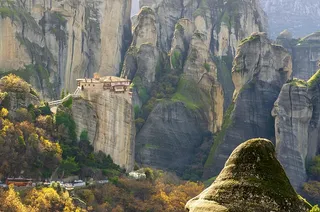
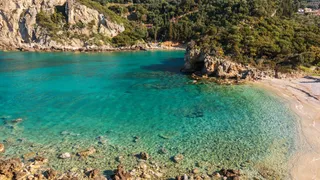
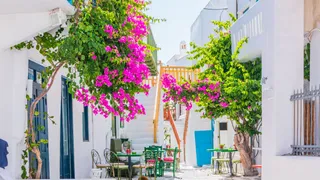
Greece is attracting more and more curious camping enthusiasts – and for good reason, as its landscapes are incredibly diverse. In Greece, you can expect stunning beaches, crystal-clear water, and the typical Greek flair created by the white-and-blue houses. Thanks to its particularly warm climate, the country is ideal for adventurers seeking sunshine and warmth, making camping in Greece possible almost all year round. Greece’s nature has just as much to offer: mountain ranges, rocky landscapes, forests, rugged coastlines, and dream beaches – everything an adventurous heart could wish for. Whether wild camping with a campervan is allowed in Greece, under which conditions, and in which regions, you’ll find out in this article.
Wild camping Greece: Permitted or not?
We have bad news for all those who were looking forward to a relaxed wild camping time with their campervan along the countless beaches of Greece. The legal situation regarding wild camping in Greece unfortunately is very clear. Wild camping is basically prohibited by law. In the law N. 2160/1993 article 4 paragraph 12 are the legal foundations of wild camping in Greece, which state that it is forbidden to put up tents or caravans on archaeological sites, on beaches, in public forests as well as public places.
What are the penalties for wild camping?
Anyone caught wild camping in Greece faces fines of up to €3,000 or even imprisonment for up to three months. These are not always enforced, especially in the low season the risk is lower than in the high season and wild camping is tolerated by the Greeks and authorities with a little luck.
Buuuuut there are a few gray areas and ways, so chances are good that overnight camping will be tolerated. We want to tell you about them, but can by no means guarantee that they will be tolerated.
Where should you be especially careful, and where is there more tolerance?
Especially during the summer months and high season, heavily frequented areas such as tourist hotspots, nature reserves, and beaches are regularly checked by the police. In these places, we strongly advise against staying overnight with a campervan. Prohibition signs are often clearly visible at these spots.
If there are no signs, overnight parking is generally tolerated in Greece. Particularly in the low season and during the winter months, controls are less frequent than in peak season, which means you may even find spots near the beach or directly by the water where overnight stays are tolerated. This is also one of the reasons why Lefkada is considered a real insider tip for wild camping within the vanlife community during the low-season.
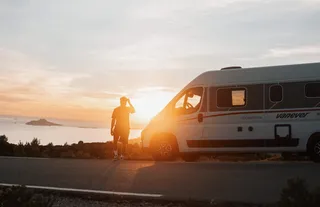
A crucial aspect to keep in mind is the difference between “overnight parking” and “camping.” The former refers to discreet parking, which is far more likely to be tolerated than actual camping. Our tip is to avoid using awnings, camping chairs, or tables so as not to give the impression that you are setting up camp. This way, you’re much more likely to be able to “park overnight” for one night.
You might not stay in one place for very long with your camper, but in return you’ll get to see even more beautiful places in Greece. To find spots that are legally less risky for wild camping, apps like Park4Night can be very helpful. There, fellow campers share their experiences at different locations, which can help you assess an area better in advance.
Where can you park your camper?
The safest option is, and always will be, staying at an official campsite. However, campsites in Greece are generally more basic than those in popular European camping countries such as Italy, Portugal, or Spain. In some cases, they may only offer a simple water supply and no electricity. On the plus side, campsites are relatively inexpensive. That said, you should also keep in mind that most campsites are only open between May and September. Find out more about camping in Greece on our blog. Traveling through Greece with a motorhome in autumn and winter can therefore be a bit challenging if you plan to rely on official campsites. During the off-season and less touristy months, however, your chances increase of discovering quieter, more remote spots where overnight parking with a motorhome may be tolerated.
When it comes to parking, more and more restaurants and bars also offer their parking lots as overnight spots for motorhomes in exchange for attracting new customers and earning additional income from food and drink sales. In some cases, campers are even allowed to use the restaurant’s sanitary facilities.
What else do you have to look out for when wild camping in Greece?
Camping – and especially wild camping – is an indescribably beautiful adventure for most people. Pure freedom and nature. But when you’re completely alone in the middle of nature, are there things you should keep in mind as a wild camper?
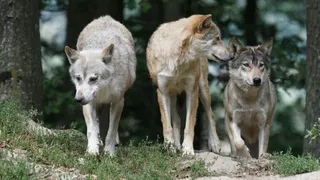
As mentioned before, wild camping or overnight parking is best suited to more remote areas where you don’t disturb anyone and where the chance of encountering authorities is lower. However, it’s important to know that there are still wild bears and wolves living in the northern parts of the country. They usually avoid humans, but especially in these regions you should be careful with food leftovers so as not to attract any unwanted visitors.
Extra caution is also required on the roads! The roads are not as smooth as we are used to in Germany, and large potholes are not uncommon, so it’s important to stay alert while driving. In addition, traffic rules are not enforced as strictly as in Germany – something Germans often notice when traveling in other countries.
One rule that is especially important in Greece, particularly during the summer months, is to never light an open fire outdoors. Due to the high temperatures, the risk of wildfires is extremely high.
How do I behave properly when wild camping?
Most of us camp for the love of nature and the incomparable feeling of freedom. Unfortunately, in many cases this harms both nature and the local economy. Here are a few tips that you should keep in mind when wild camping.
Leave the place as clean as you found it!
Be careful not to disturb animals and nature through noise or fire!
Dispose of gray water at designated stations!
Be considerate of residents and fellow campers!
Support the local tourism and give back to your vacation destination!
Conclusion
It is clear that wild camping in Greece is prohibited by law. The legally safest option is still offered by official campsites of the country. However, these are kept much simpler than the camping facilities we know from other countries. However, inconspicuous freestanding - which means parking in quieter places for a night - away from beaches, archaeological sites, public forests as well as public places is often tolerated. Especially outside the high season, when the country's tourism is much lower than in summer and most official campgrounds are closed, freestanding in more remote locations is often tolerated. Due to the year-round mild climate, it is also definitely woth it to go on a camping adventure in the low-season.
Are you ready to go on an adventure in Greece's wilderness?