Cookies are essential for the smooth and secure operation of our website. They help us to monitor performance and provide you with an optimized, personalized user experience.
The cookie settings can be adjusted at any time in the footer of the page.
We all love exploring the world and experiencing new things. Getting to know new cultures, languages, and people—broadening our horizons. But in an era of climate change and travel shaming, the anticipation and the experience itself are diminished.
That’s why we’d like to talk about how to travel mindfully and sustainably, and what each of us can do to make a positive impact.
Eine Reise mit dem Wohnmobil ist eine wunderbare Möglichkeit, das Urlaubsziel in aller Ruhe zu erkunden – diese Art des Reisens wird auch als „Slow Travel“ bezeichnet. Wie der Name schon sagt, verläuft die Reise gemächlich.
But that doesn’t mean that travel in the van is limited to a maximum speed; rather, the route to the destination—if one is even set—is punctuated by numerous stops along the way. Every place where we stop to rest is explored like a local—at a leisurely pace. Whenever possible, we use public transportation, visit a small, cozy café serving regional products, or stop by a boutique featuring local goods.
The goal is to experience the place you’re visiting in its entirety, getting to know the people, culture, traditions, and customs mindfully and without rushing. Once you feel you’ve experienced the place sufficiently, the journey continues. Of course, you don’t have to stop at every village or sight, but you should avoid “racing through” several hundred kilometers a day just to reach a destination as quickly as possible.
Each destination can look very different—it could be a big city, a small village, a spot surrounded by nature, or anything in between. With slow travel, either the duration of the trip is significantly longer or the distance to the destination is shorter than with a typical vacation.
To fully embrace mindful travel, you should set aside plenty of time for distant destinations so you can fully savor the journey. If you don’t have that much time, you should explore your home region or the surrounding areas. This way, everyone can consciously get to know the surroundings where they grew up or moved to, and discover something new in the familiar.
In addition to slow travel, there are other ways everyone can help make camper trips more eco-friendly. Here are a few tips and tricks:
When you arrive at a parking spot, take 5 minutes to clean up any litter left behind. Use your own CleanUP Kit, which you can get at the Koop Shop. More on that in a moment.
Only stay overnight at designated RV parks, campgrounds, or private parking spots.
Do not relieve yourself in nature.
Shop regionally and seasonally at markets, opt for packaging-free options whenever possible, and bring small reusable bags from home.
Dispose of trash only in designated containers—do not throw organic waste into nature, as it decomposes only under very specific conditions.
Light fires only in fire pits or designated areas when weather conditions are appropriate.
Share what you’re doing—no one should be lectured, but the more people you make aware of these issues with sensitivity, the more people will be sensitized.
Calculate your carbon footprint using a CO₂ calculator and offset it by making a donation to an environmental organization. It is important to note that the primary focus should still be on reducing emissions, and this should serve merely as an additional measure.
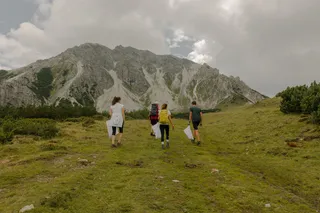
The non-profit organization PATRON Plasticfree Peaks, based in Pfronten, has made it its mission to play an active role in the restoration and preservation of natural areas. PATRON aims to raise awareness and foster a commitment to preserving our natural environment. For this reason, the association organizes the Patron CleanUP Days in various regions. Working in self-organized teams, participants clean up their favorite hiking trails and rid nature of litter left behind. To this end, every litter collector receives a free CleanUP Kit consisting of a reusable fabric bag and stainless steel tongs, both designed for reuse.
The bags are manufactured in Europe and can be easily washed with water and reused after use. The recyclable material allows for easy disposal in the recycling bin, so that the materials can be properly recycled at the recycling center.
The CleanUP Map shows the pickup locations for CleanUP kits, the drop-off points for trash after the cleanup, and all the tours planned so far by participating teams. You can also register your own team through the map. Whether at an official stop on the Patron CleanUP Tour or during a privately organized tour, anyone can join in and do their part to preserve nature. Step by step and hand in hand, we can achieve the vision of #plasticfreepeaks together.
Here at Vanever, we also think it’s incredibly important that you protect nature while traveling and dispose of your trash properly. Anyone interested in taking a cleanup kit on vacation and helping to leave their travel destination cleaner than they found it is warmly invited to do so. For this purpose, we’re providing you with a cleanup kit for your trip from our partner, Patron. Just ask our location team about it when you pick up your camper.
Conscious and sustainable travel, especially in a camper, is definitely possible. Here are our ultimate slow travel tips:
Explore local markets: discover regional foods and handicrafts to get to know the local culture and people
Support local businesses: choose small restaurants and local shops & tour operators to support the local economy and have authentic experiences
Take time to relax: plan relaxation breaks into your trip to recharge your energy and reduce stress.
Learn a few words of the local language: try to learn a few words or phrases in the local language to connect with locals and better understand the culture.
Take a digital detox: spend less time online and focus on your surroundings to enjoy them more fully.
Attend local events: Find out about local events such as festivals, fairs, or concerts and incorporate them into your travel experience.
Walk or bike: Explore the area on foot or by bike so you can experience nature and your surroundings more fully.
Get involved in environmental protection: Take the time to participate in official local environmental protection projects or get involved privately with a CleanUP
Avoid crowded tourist spots: Avoid crowded tourist spots and explore lesser-known places instead to have a more authentic experience.